Building Veyra Thorn
One character, first level to twentieth — four classes, two of them prestige classes, out of two books — built in the workshop at /forge without saving anything. Every picture below is that build, photographed from the running application. Nothing here is a drawing of a product.
Before you start
You will need to sign in with Google to build. This guide is the part of Realms Unbound anyone can read; the workshop, the archive and the table are for signed-in players. Follow a link to the workshop without an account and you are sent to sign in and brought straight back to it, so nothing you started is lost on the way.
Nothing on screen is invented. Where the workshop states a rule it prints the book and the page beside it, in gold. Where it cannot establish something it says so in those words rather than filling the gap. That is the whole reason this application exists, and you will see it happen twice in the feats step below.
Who are they?
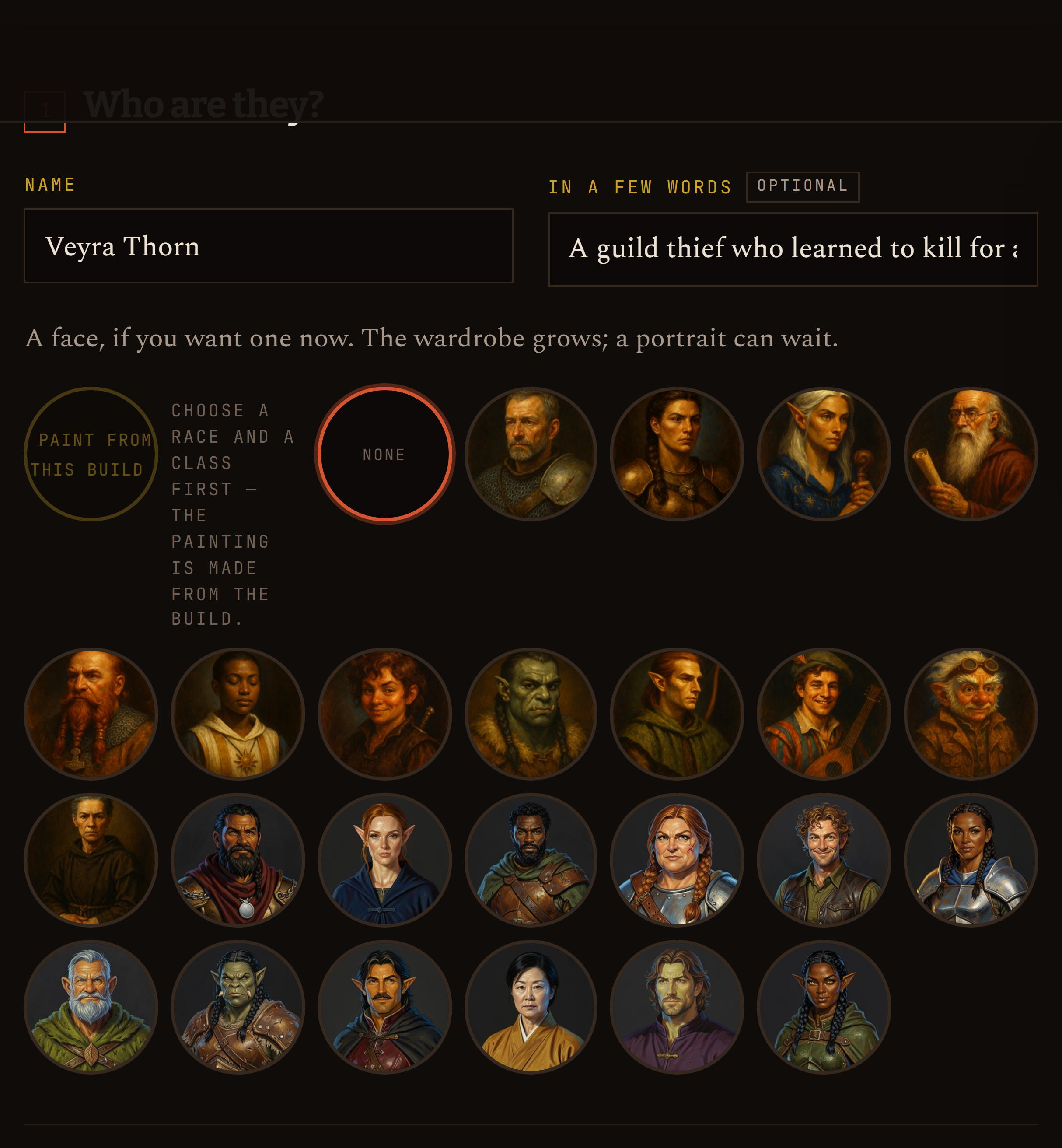
A name is the only thing the workshop needs to begin. The concept line beneath it is not decoration: the advisor reads it, and so does every Fill the rest button (of the skills, the feats, the spells) when it ranks which of the legal options suit this character. Veyra gets a sentence that names what she was and what she became, because the rest of the build has to follow from it.
What race are they?
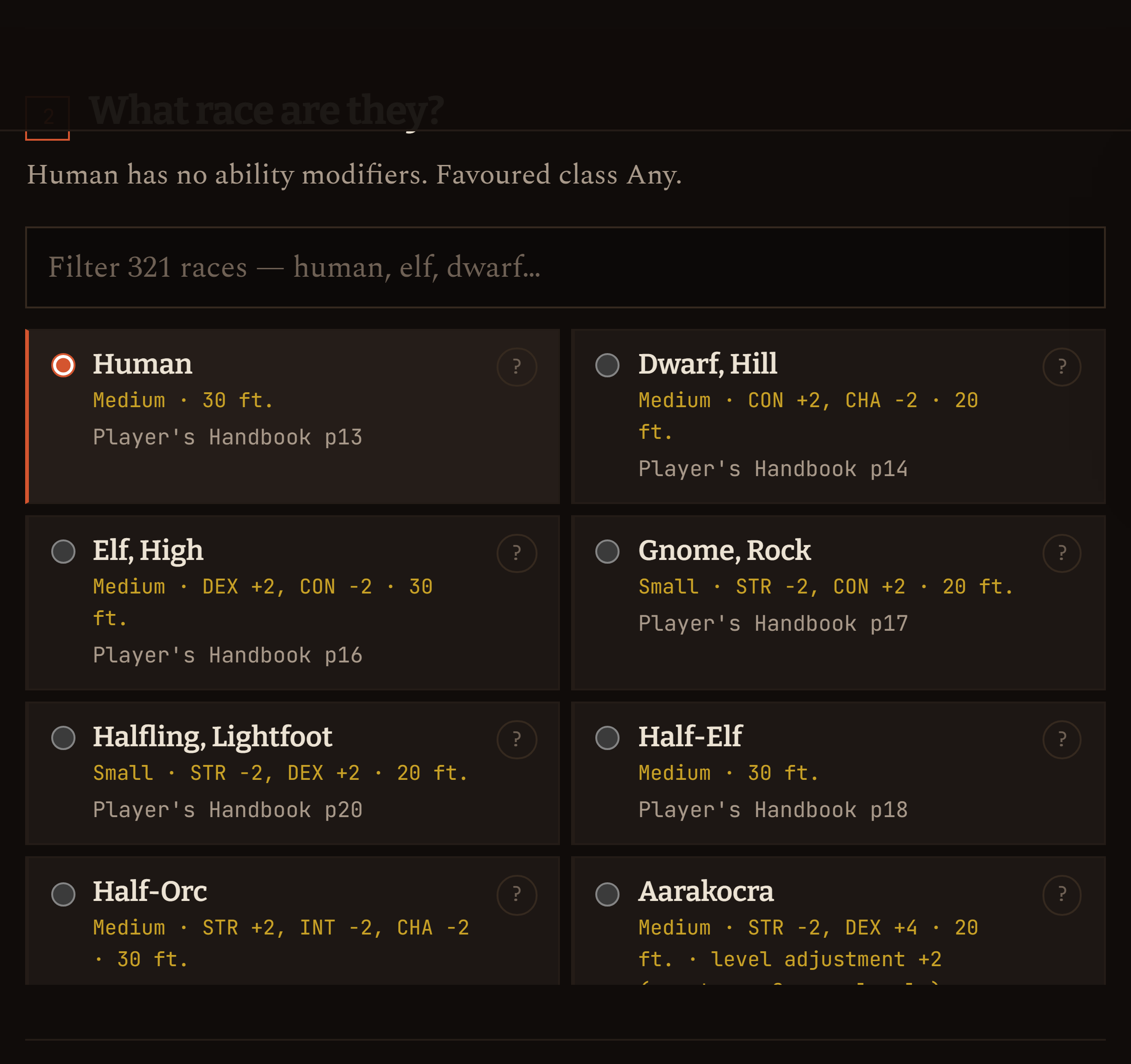
The race sets ability modifiers, size, speed, a favoured class, and both language lines — the ones granted outright and the ones you may choose later. Veyra is human: no ability modifiers, an extra feat at first level, extra skill points every level, and a bonus-language list that reads Any.
Every row carries the book it came from. The ? beside a race opens its archive card — the same record the engine reads, not a summary written for the screen.
A class, and then another one
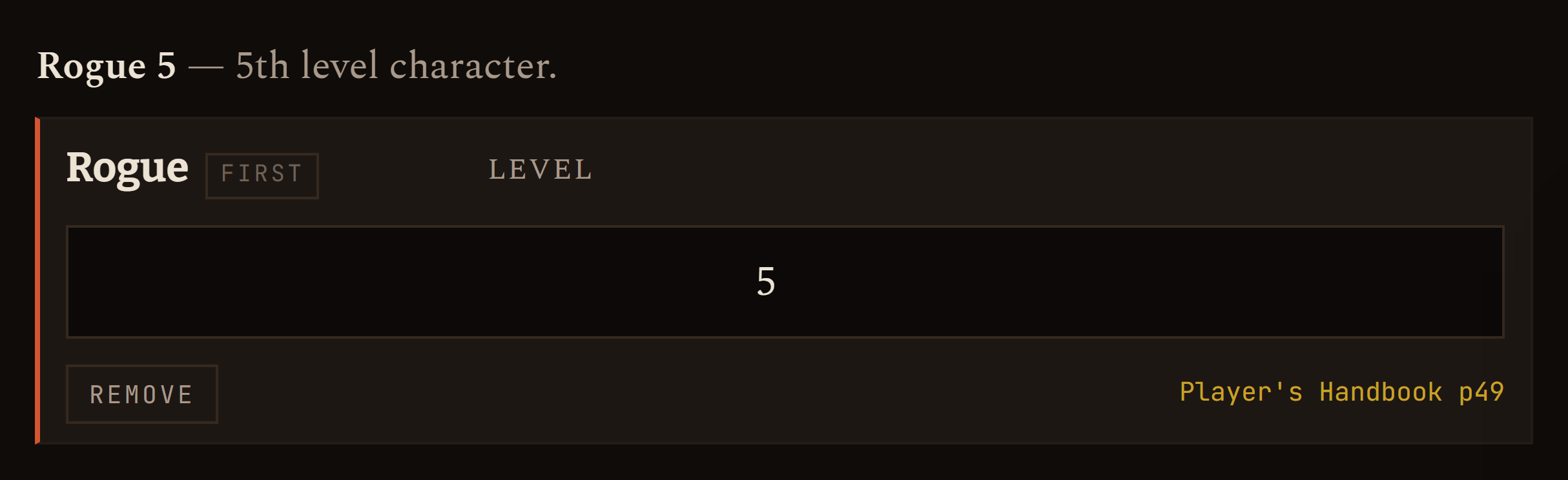
Veyra starts as a rogue, and starts at fifth level rather than first — the workshop takes a level in the box beside the class, so a character who begins above first level is made in one pass instead of twenty. The class that goes in first is marked FIRST, because it is the one whose skill list was bought at the class rate.
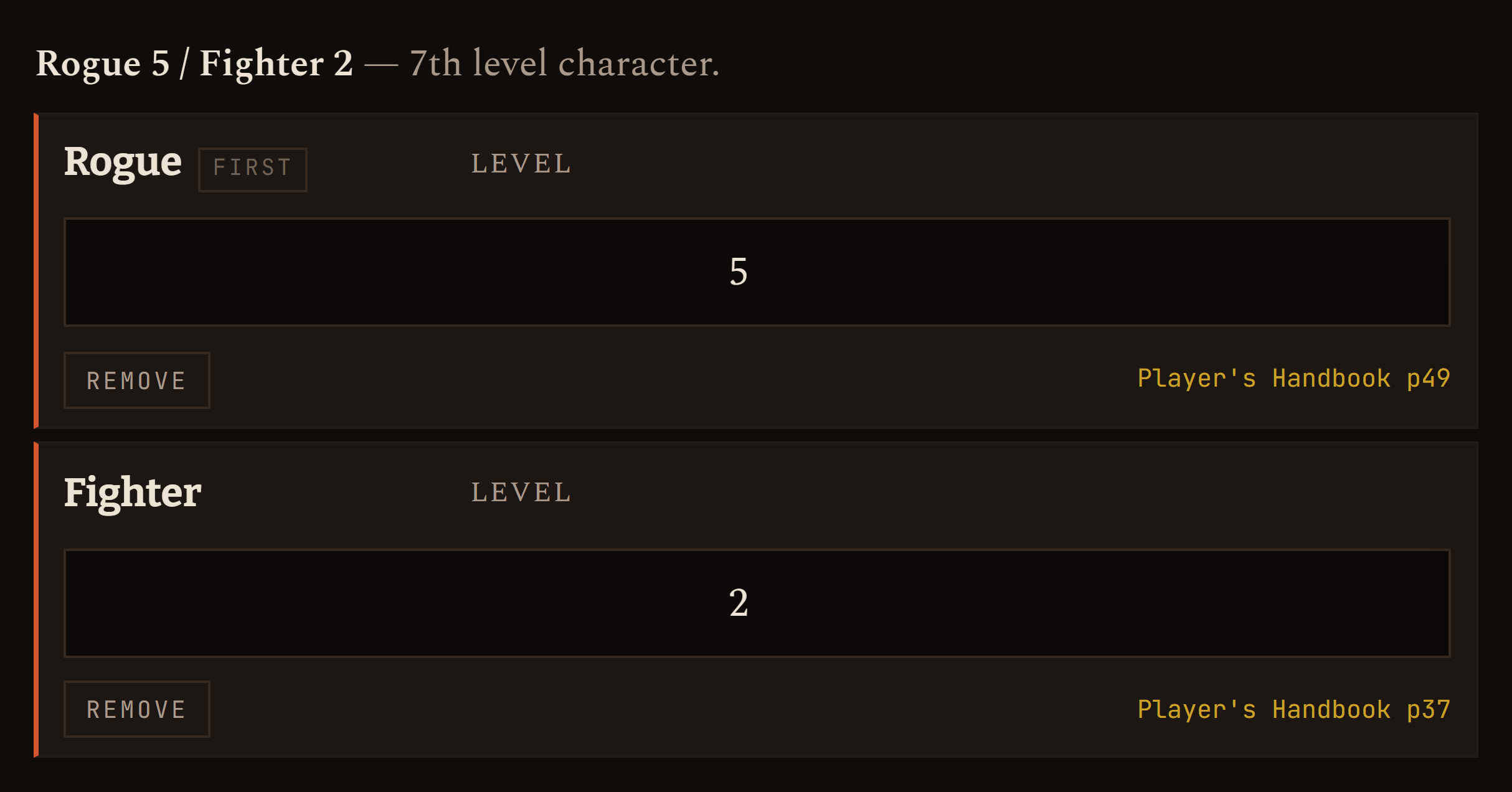
Multiclassing is not a mode you switch on. A second class is a second row: two levels of fighter, for the bonus feats and the better base attack. The header above the rows keeps the running total — the character level, which is what every cap and every prerequisite in the rules is measured against.
Prestige classes, and what they ask of you
A prestige class is not a class you may simply take. It prints requirements, and the workshop prints them before you take it rather than refusing you afterwards. The Assassin wants a particular alignment, ranks in Hide and Move Silently, and to have killed for pay — which is why the concept line at the top of this build says what it says.
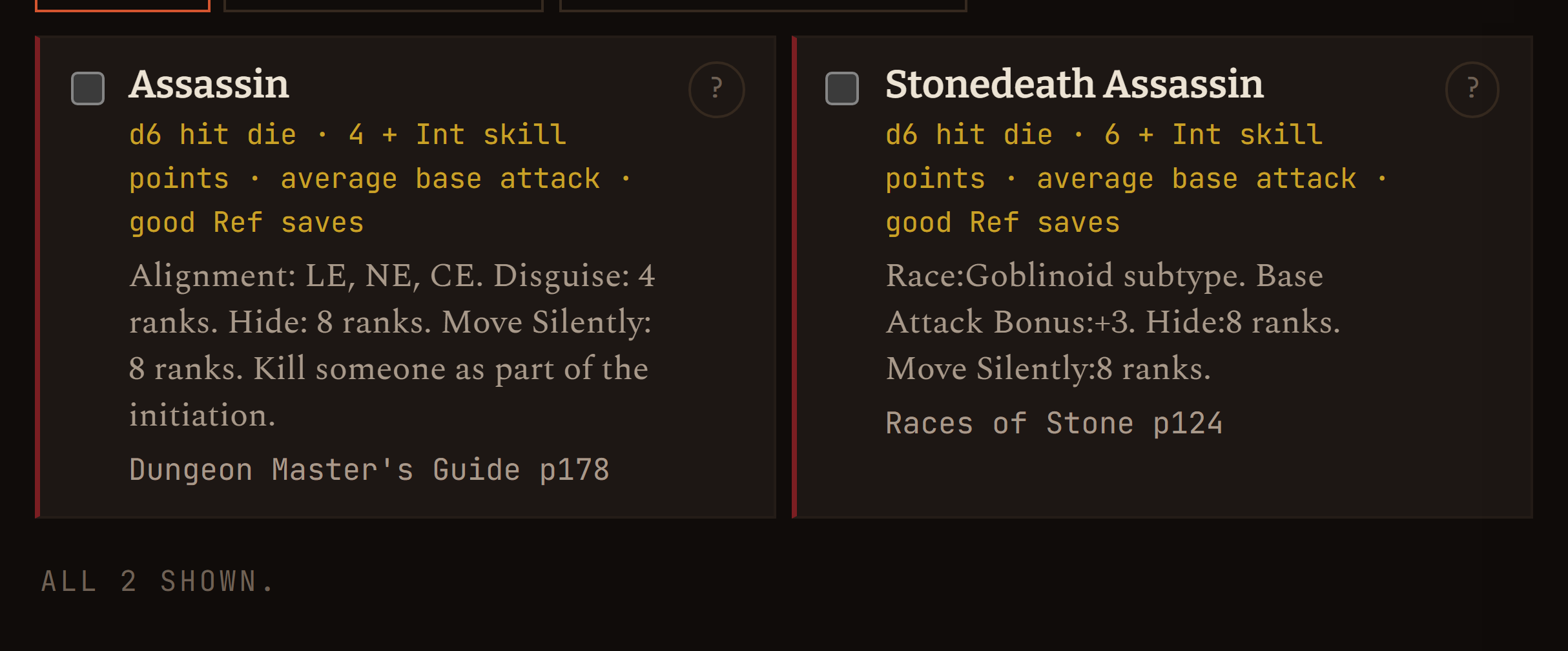
Two prestige classes go in — the Assassin and the Shadowdancer, both out of the Dungeon Master's Guide — and the build reaches twentieth level. Four classes, two books, one character.
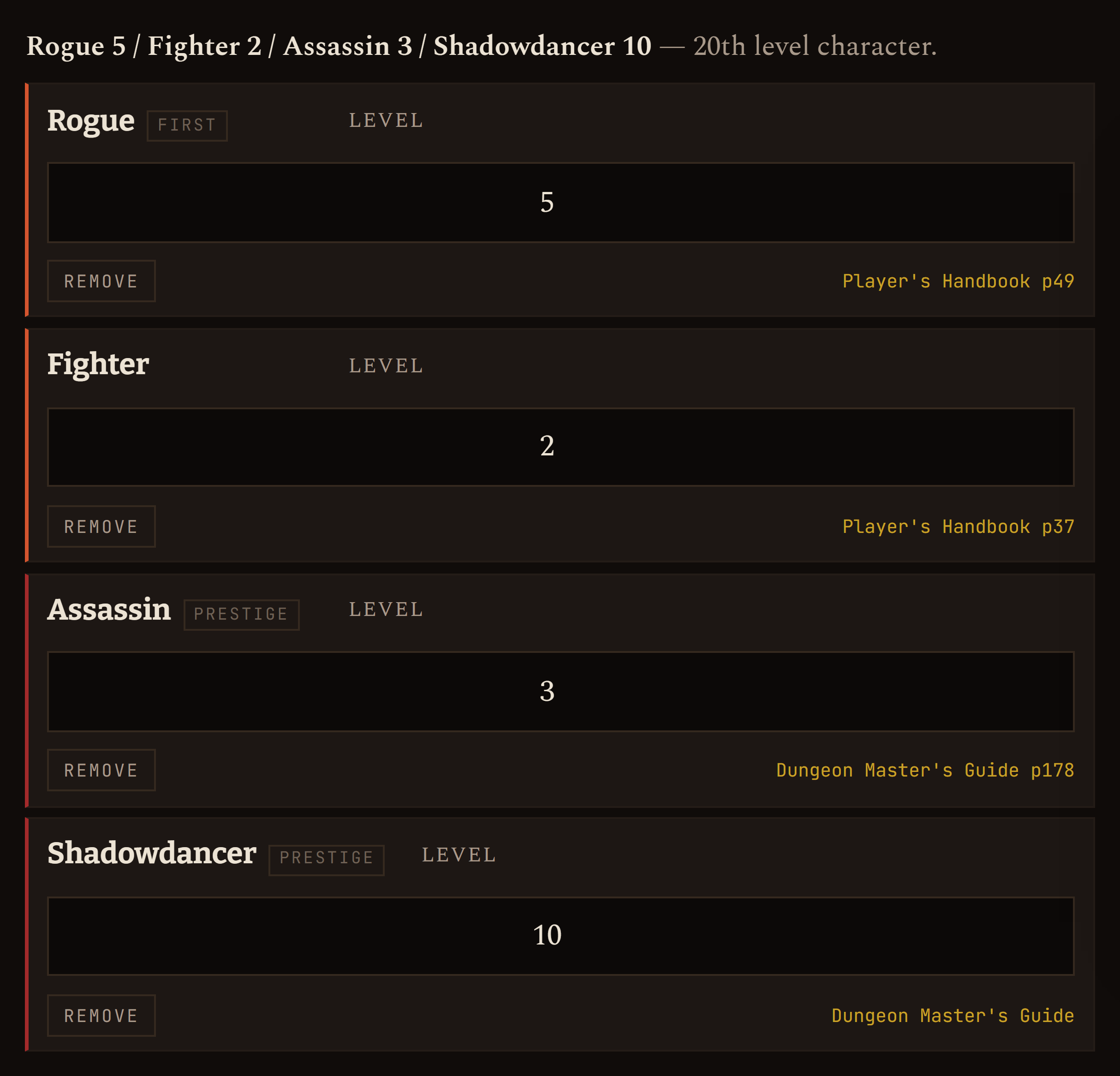
| Levels | Class | Kind | Where it is printed |
|---|---|---|---|
| 1–5 | Rogue | base | Player's Handbook p49 |
| 6–7 | Fighter | base | Player's Handbook p37 |
| 8–10 | Assassin | prestige | Dungeon Master's Guide p178 |
| 11–20 | Shadowdancer | prestige | Dungeon Master's Guide |
The Shadowdancer's row carries a book and no page. That is not a formatting slip — the record in this archive has no printed page on it, and the workshop would rather show you a citation with a hole in it than invent the number that fills it.
The six numbers
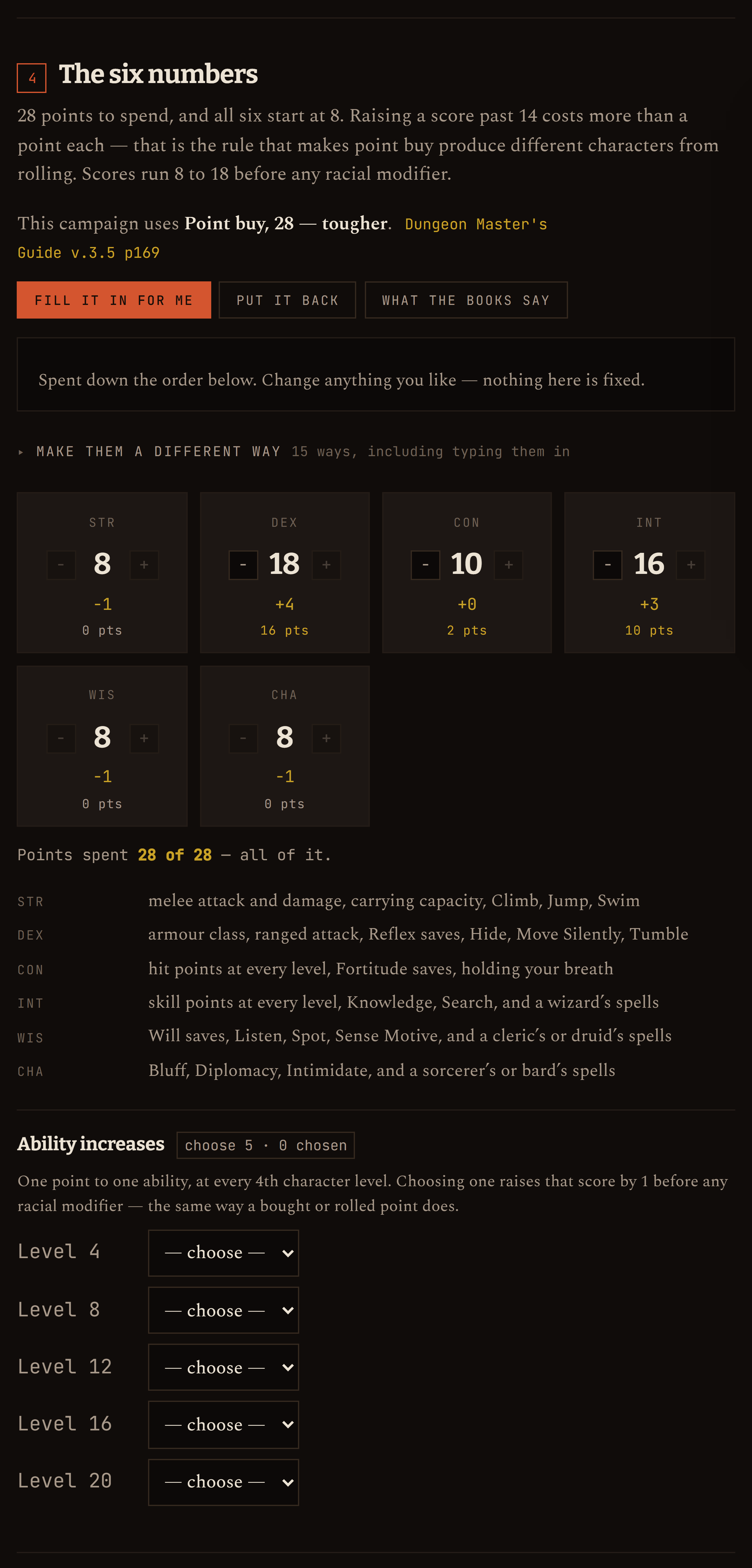
How the scores are made is the campaign's decision — point buy, an array, rolled, or typed in by hand. Under point buy the workshop prints what each point costs as you spend it, and the reason that matters: raising a score past 14 costs more than a point each, which is the rule that makes point buy produce different characters from rolling.
Fill it in for me spends the budget legally against the concept; everything it fills stays yours to change, and is marked as filled rather than chosen so you can see what you have not looked at yet.
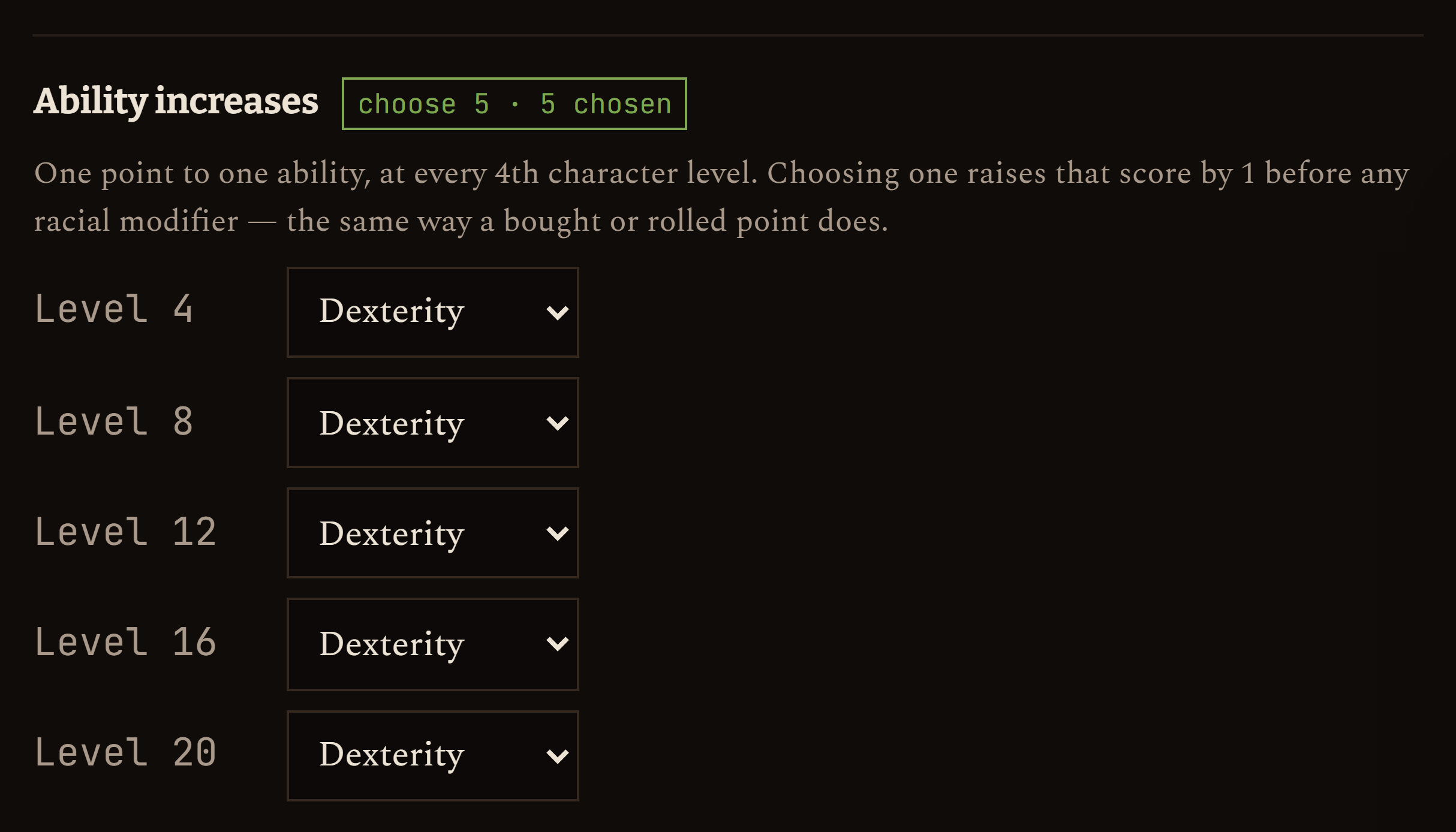
A twentieth-level character has earned five ability increases — one point at 4th, 8th, 12th, 16th and 20th. The workshop offers all five at once, each against the level that granted it, so a character built above first level does not have to be walked up one level-up screen at a time. Veyra puts every one into Dexterity.
Skills
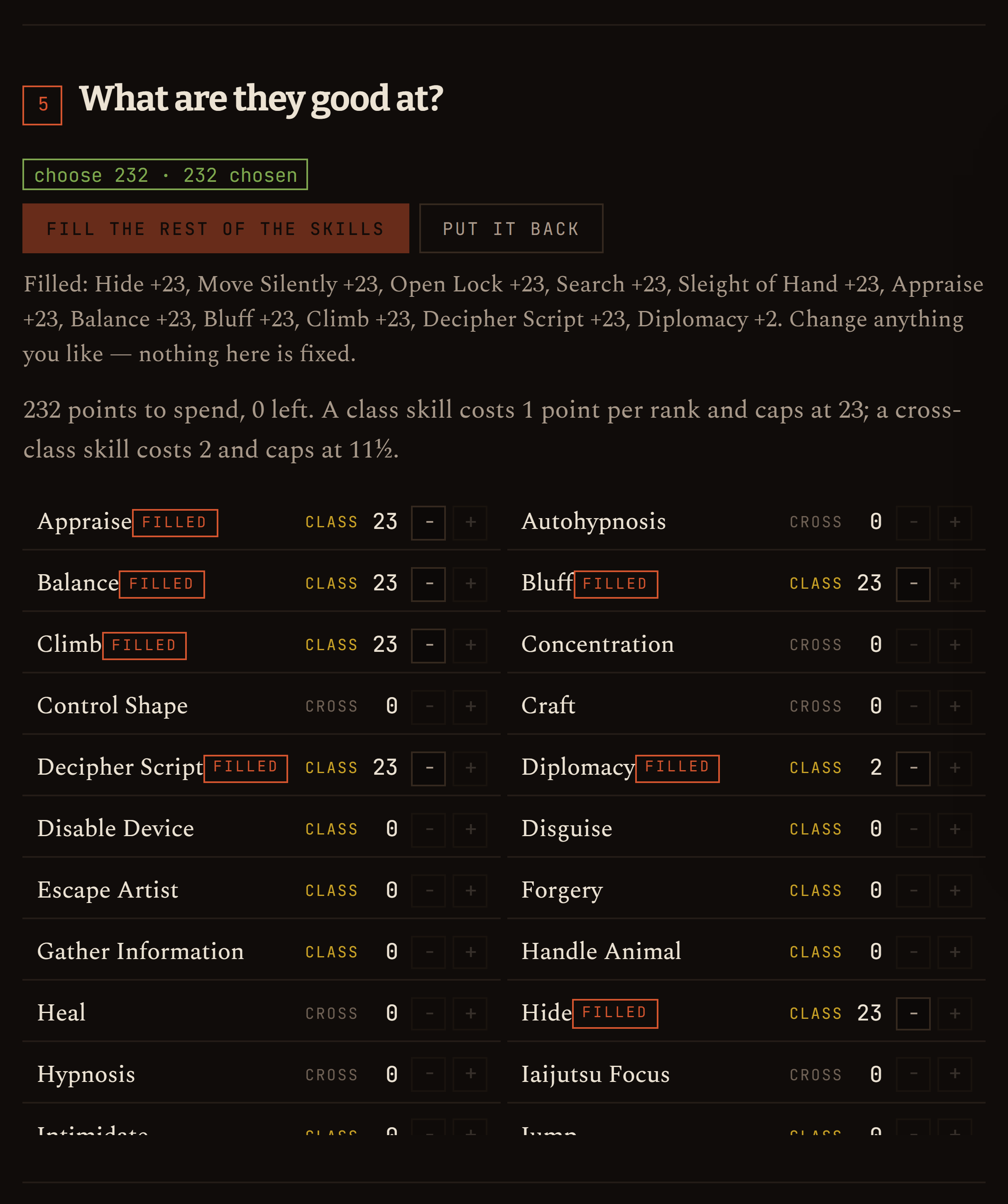
Skill points are one shared budget, not a per-skill allowance, so the counter sits once above the list: choose N · M chosen, red when you are over, complete the moment the two match. A skill is a class skill if it is a class skill for any of the character's classes, and the maximum rank is set by character level — both of those are multiclassing rules, and both are the engine's answer rather than the page's.
One detail worth reading twice: the cross-class maximum is half the class maximum and it is not rounded down. That half rank is printed in the book, and the workshop shows it as 11½ rather than quietly taking it away.
Languages
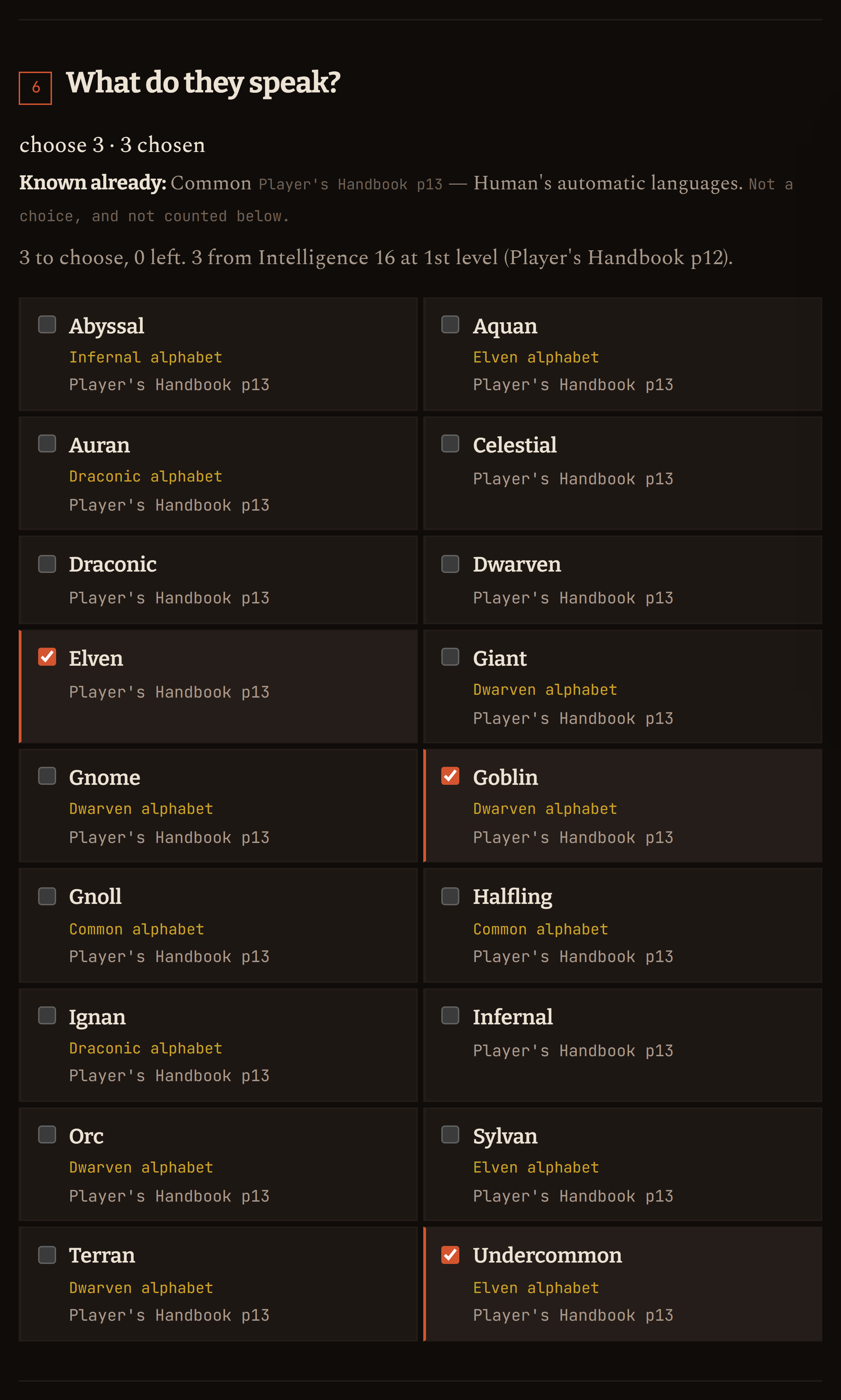
What the race grants outright sits at the top, read-only, cited to the race's own page — it was never a choice and a control that let you untick Common would be lying. Below it is a budget with two sources: one language per point of Intelligence bonus at first level (PHB p12), and one more per point spent on Speak Language, which buys a language instead of a rank (PHB p82).
Veyra has Intelligence 16, so three to choose. A human's bonus list reads any, which means every language on the p82 table except the secret ones — and that exclusion is the parenthetical the human entry itself prints, not a policy invented here. She takes Undercommon, Elven and Goblin.
Feats — and the three verdicts
This is the step where the product shows you what it is. Veyra takes Spring Attack first, deliberately out of order, before either of the two feats it requires. Watch what the workshop does with it.
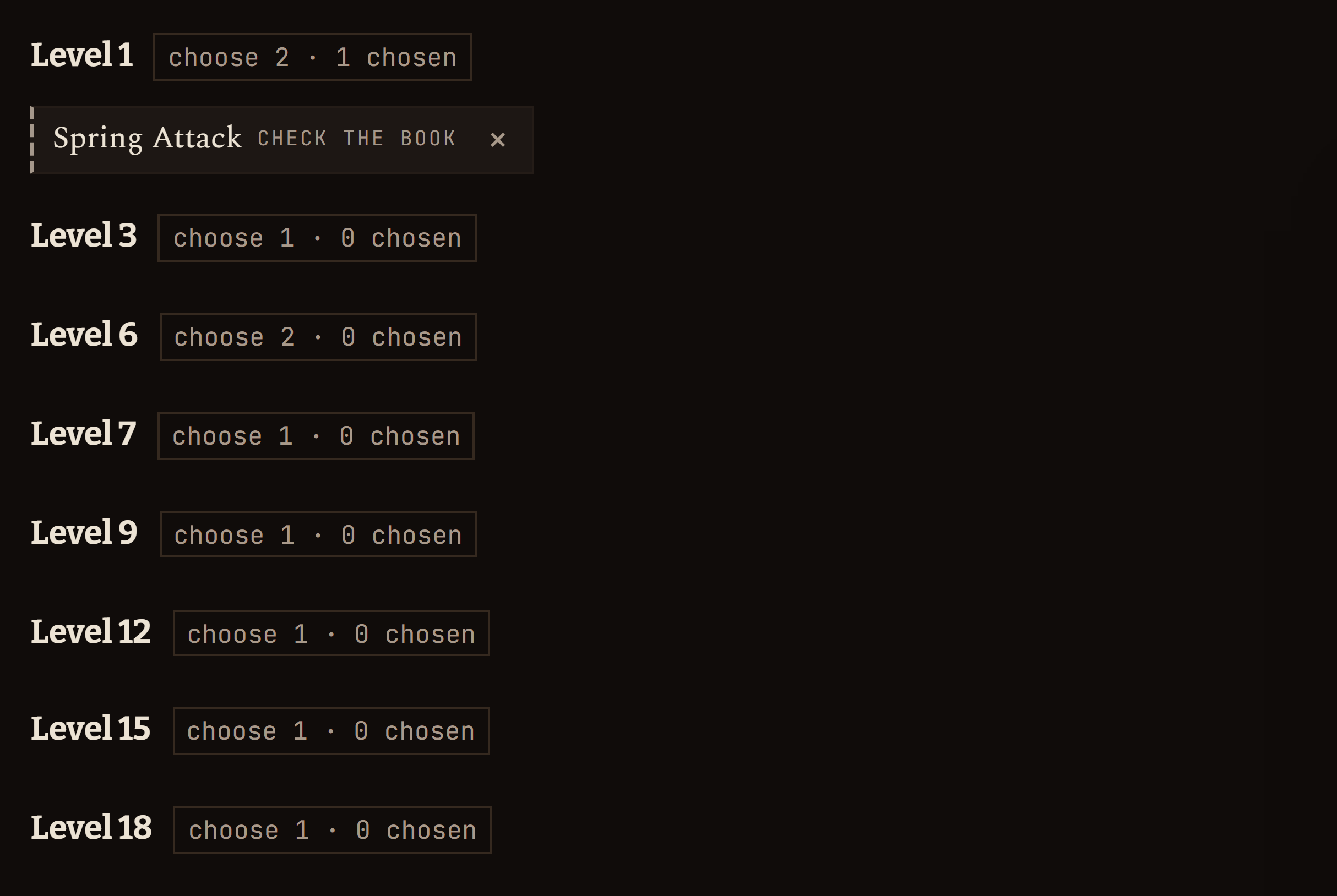
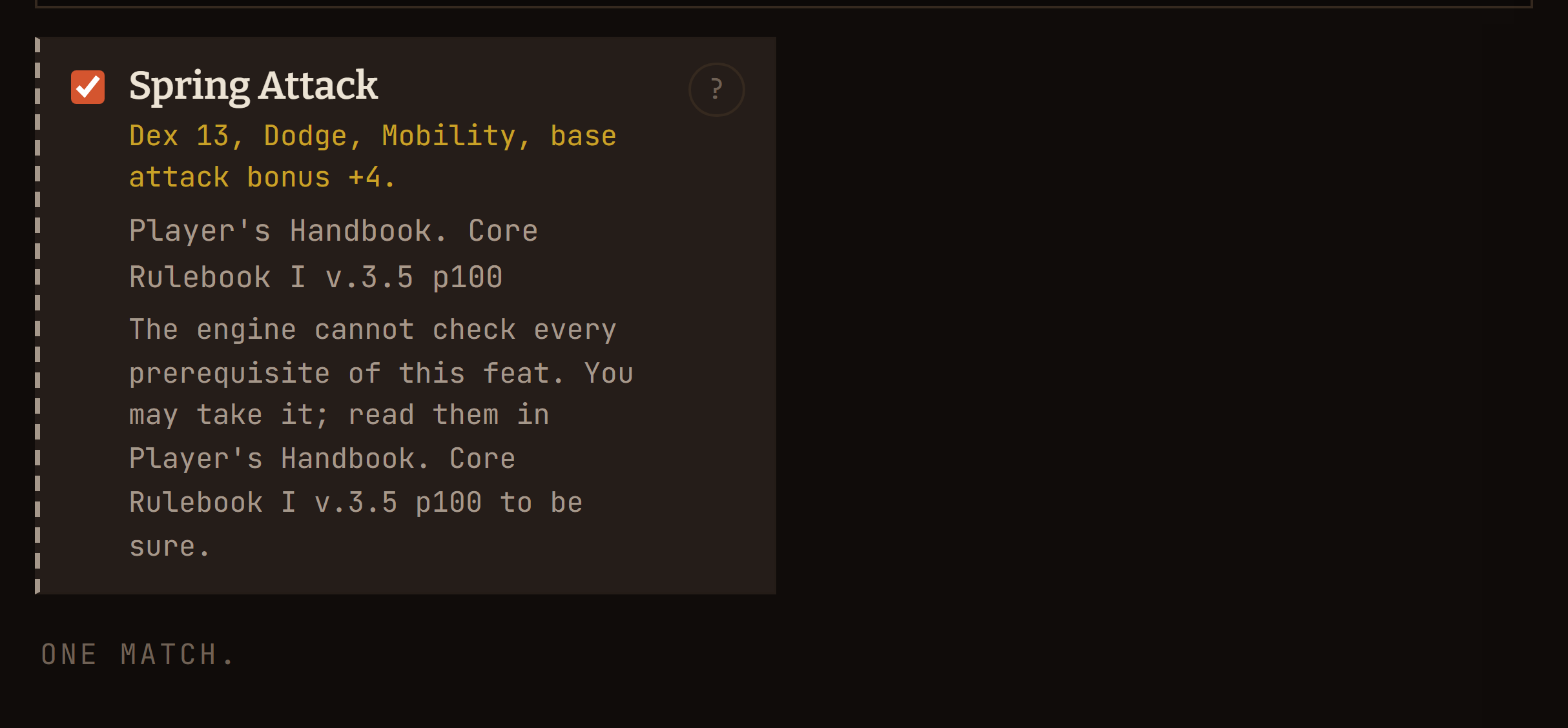
It does not say no. It says the game cannot check every prerequisite of this feat — one of them was extracted from the page rather than confirmed against it — that you may take it, and which page to read to be sure. A confident wrong refusal and a confident wrong permission are the same defect, and this is the product refusing to commit either one.
The three verdicts, and why there are three
A build's verdict is the worst of its parts, and a blocked build will not save unless you record why it should — the exception is kept on the character beside the verdict, so nothing is ever saved as legal that the check called otherwise.
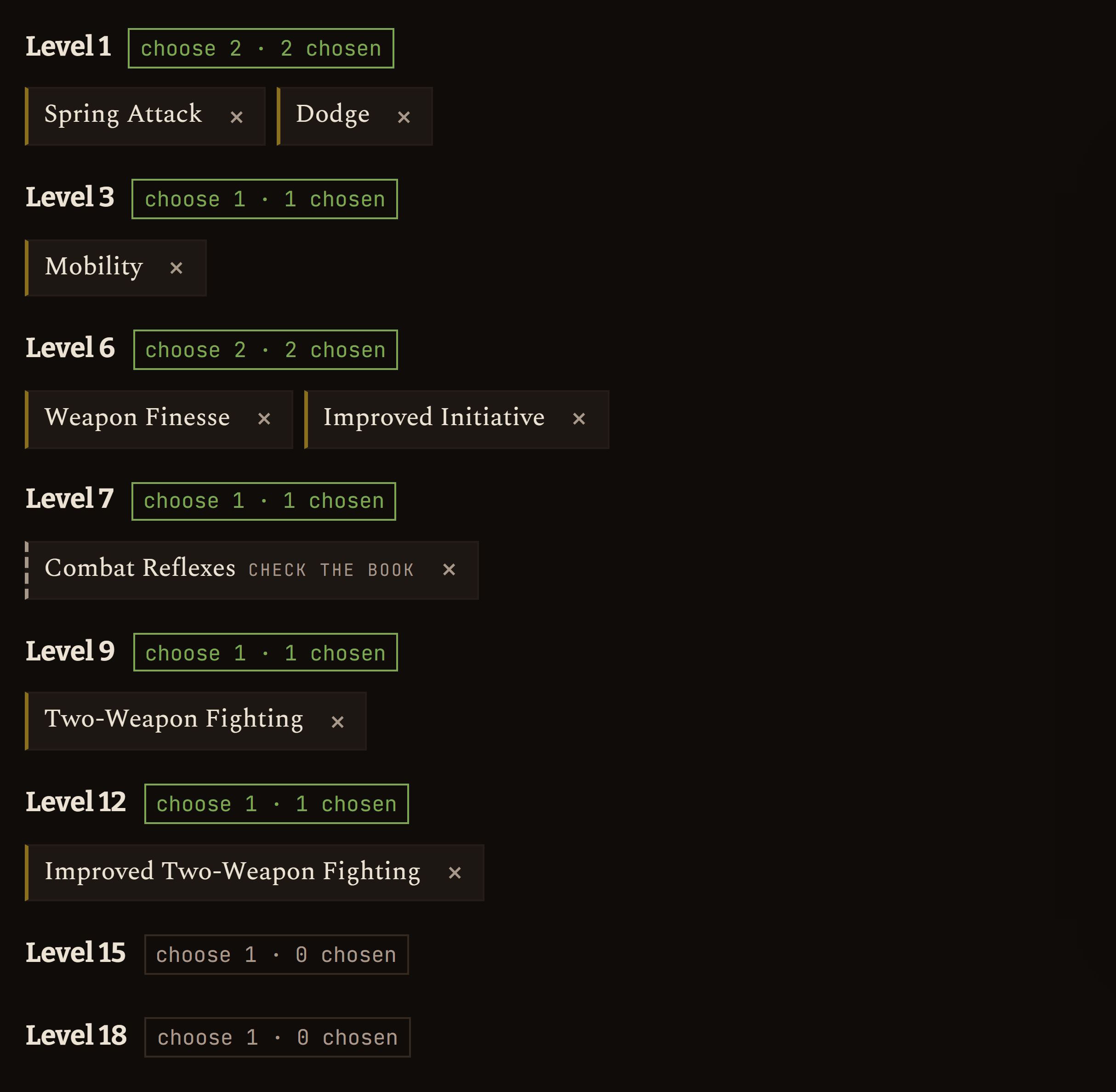
Add Dodge and Mobility and the mark goes away on its own. The same feat, the same page — what changed is the character.
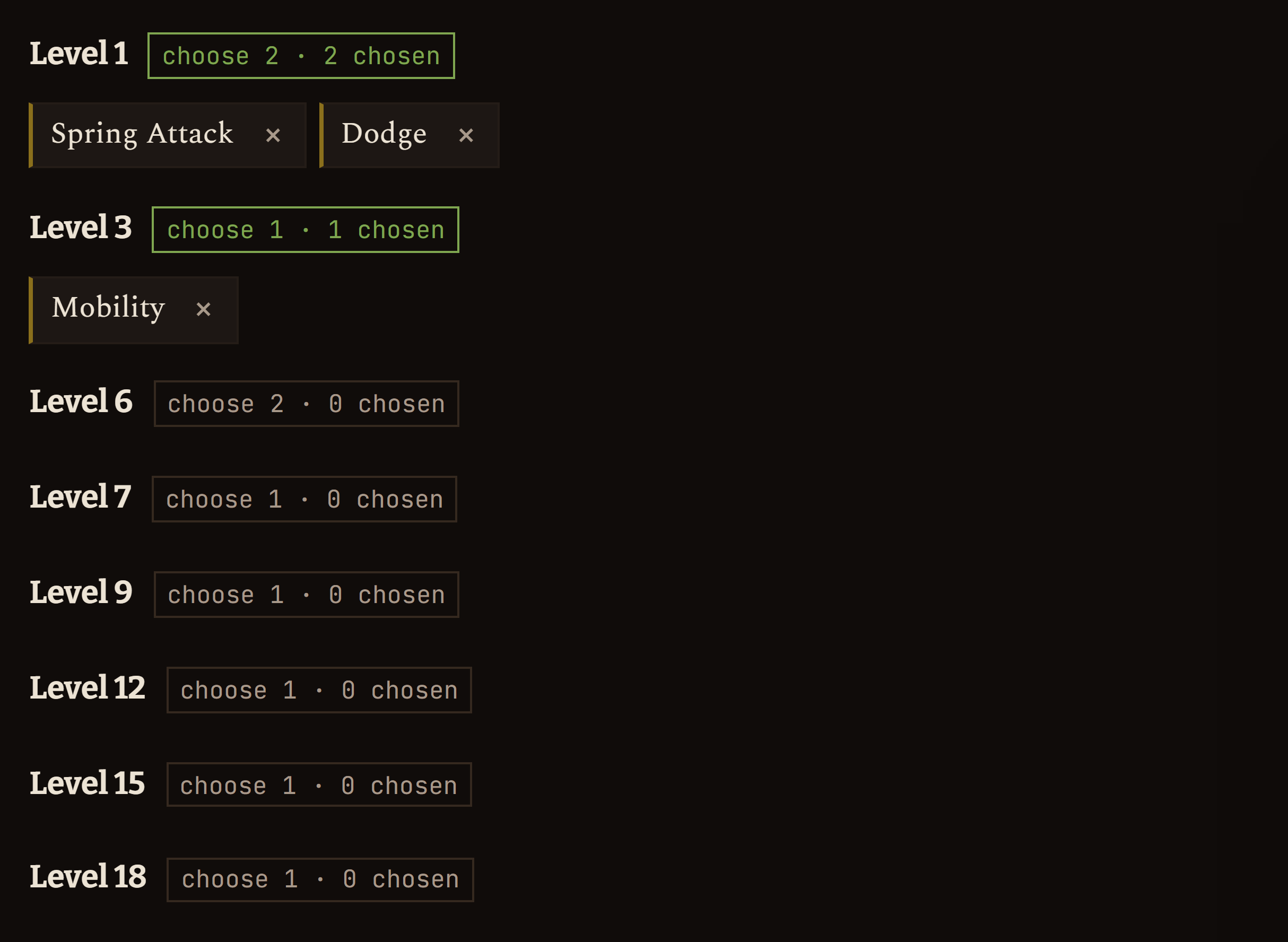
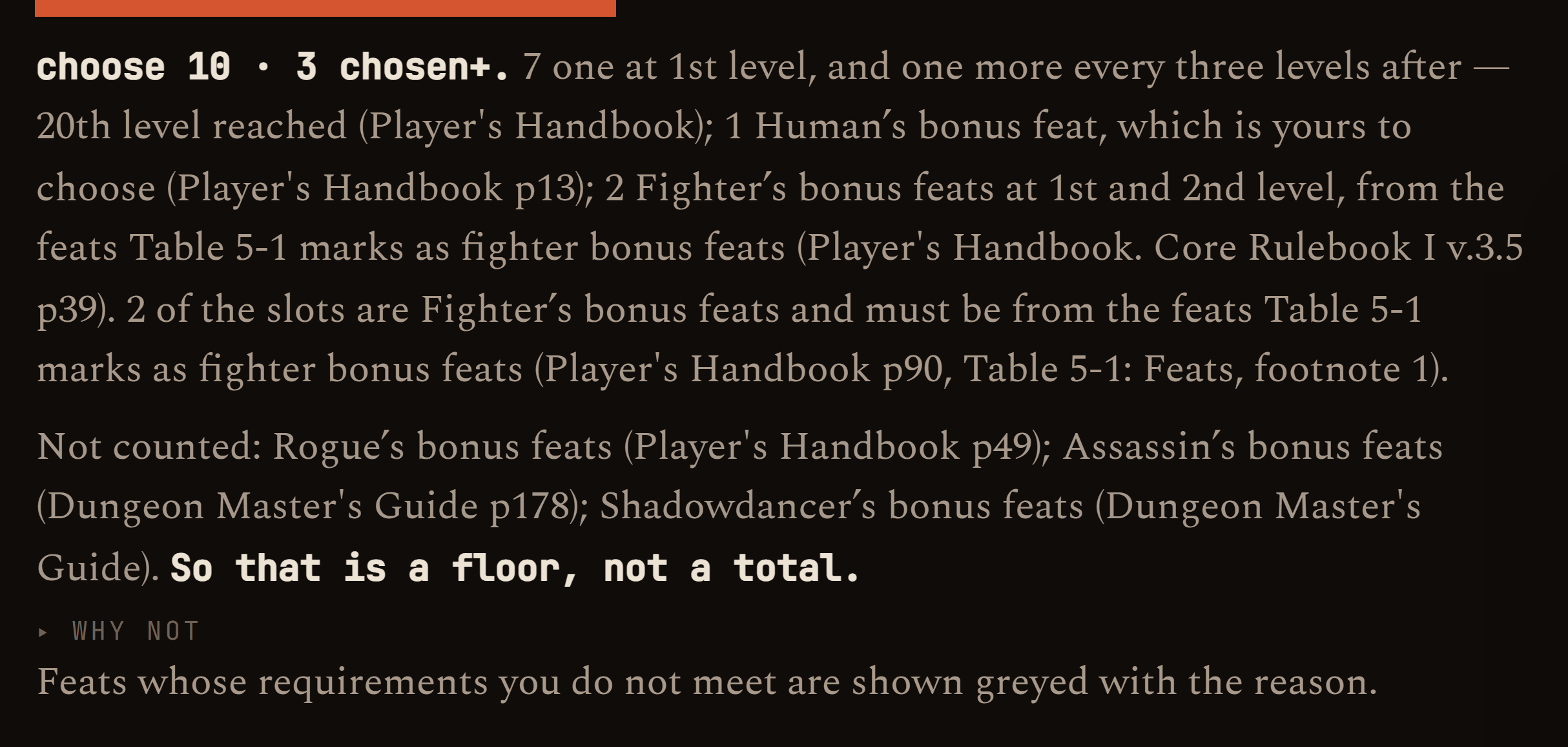
How many feats a character may have is computed by the engine and never by the page — and the number comes with a warning attached to it. The count is a floor, not a total: class bonus feats cannot be counted from this release's data, so rather than hedge the number, the workshop prints what it cannot see and names the class and the page.
Spells
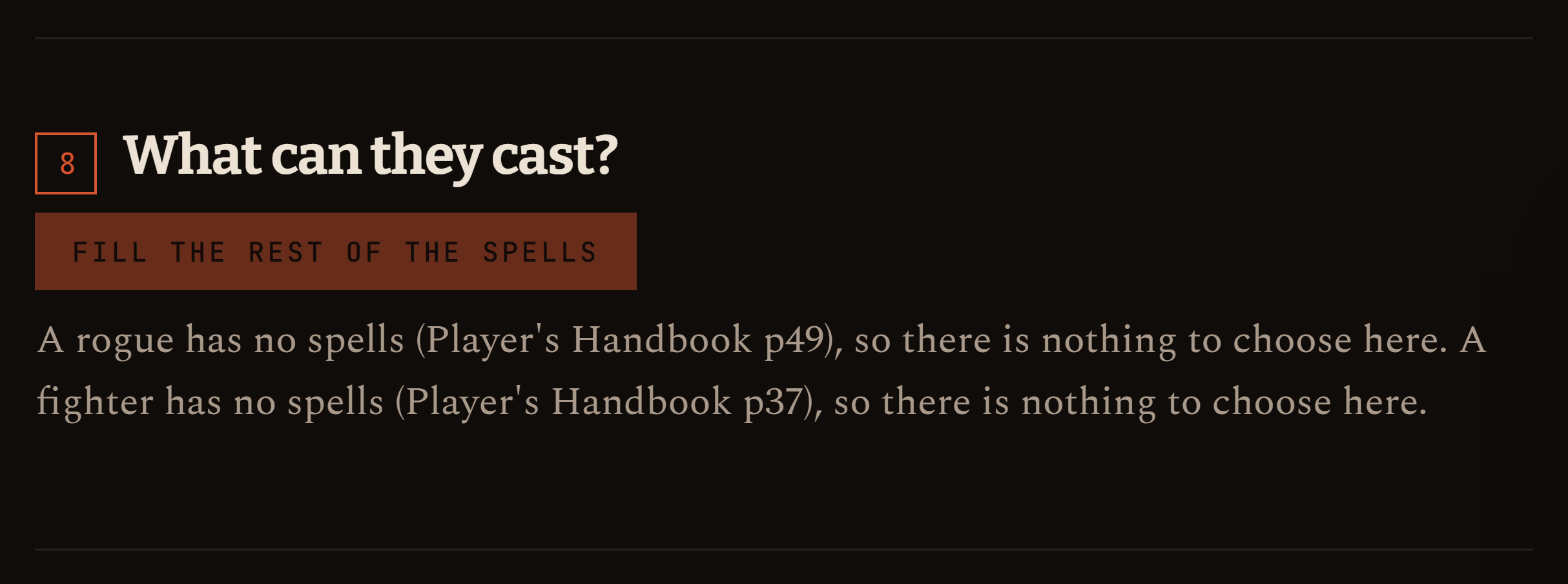
The spells step appears only for a character who casts, and it follows the class that casts rather than the class you happened to add first. That distinction is new: until this guide was written, a Rogue 5 / Assassin 3 was shown the rogue's empty spell table and told no spells-per-day table could be found — while the assassin in the same build casts from its own first level. Building Veyra is what found it.
Three arrangements, three different screens, because 3.5 has three different systems: a prepared caster fills slots from a book, a spontaneous caster knows a fixed few and casts any of them, and a cleric prepares from the whole list and chooses domains instead.
The sheet, and where each number came from
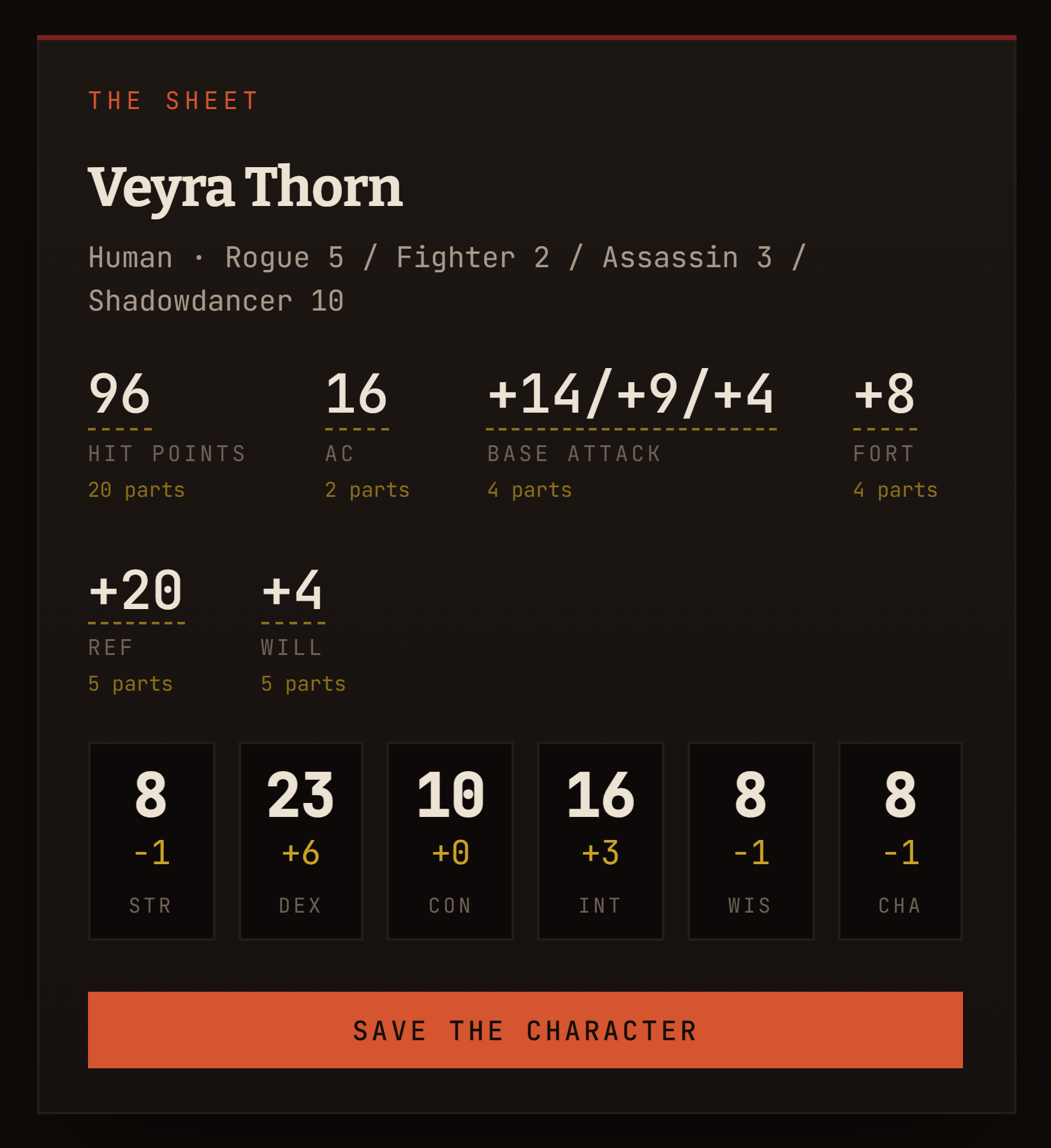
The sheet is derived, never stored. Hit points, base attack, saves, armour class, skills, carrying capacity — each is assembled from its parts, and every total opens into the parts that made it. Veyra's 76 hit points are twenty-one separate pieces: a hit die per level from four different classes, a Constitution modifier on each, and whatever else the build contributes.
That is the difference between a character sheet and a spreadsheet of a character sheet. A number you cannot open is a number you have to trust; a number that opens is one you can check against the book.
Saving, levelling, and playing her
Save asks for an account, once, and carries the build through the sign-in so nothing is lost. A saved character reopens in the workshop exactly as it left — every choice back in its place — and saving again updates it rather than making a second copy. Characters belong to the person rather than to a table: Veyra can be built with no campaign at all, joined to one later, and she outlives it when the adventure ends.
What this guide could not show you
The save itself. These pictures were taken with no account signed in, so that building one could not touch anybody's saved characters. The Save button is photographed; the account behind it is not.
Veyra in play. Building a character needs no key at all. Playing one does: the Dungeon Master and the advisor run on your own AI key, Claude or OpenAI, added once in Settings, so what you play is billed to you and nobody else. Pictures take an optional OpenAI key of their own. The play-through guide shows the key step and a whole evening at the table.